Mining Your Personal Data with AI: A 17-Year LinkedIn Cadence & Voice Analysis
I had an AI agent read 1,972 posts, 496 comments and 5,750 reactions from my own LinkedIn export. It came back with a writing persona it can reproduce, and 17 years of data on when posting turns into conversation.
Most AI writing fails because you prompt a generic model with adjectives. "Write professionally. Be inspiring." You get buzzword soup. The better move is to mine your own history. I ran my full LinkedIn export through a deterministic parser and then an LLM, and got two things back: a voice corpus grounded in what I have said for 17 years, and clear rules about cadence that I had never noticed while living them.
The 3-Step Personal Data Mining Pipeline
No vendor analytics. A local pipeline that turns the raw export into clean Markdown and a metrics table I can query.
Deterministic Ingestion
Parsed raw CSV files (Shares, Comments, Reactions), resolved multi-line quoting quirks, stripped Twitter cross-post artifacts, and normalized 17 years of timestamps.
Persona Calibration
Distilled 1,399 substantive posts into a system prompt defining voice constraints, whitespace rhythms, punchy hooks, structural breakdowns, and anti-patterns.
Cadence & Impact Mining
Line up post frequency against word count and inbound comments to find the range where posting turns into conversation.
Longitudinal Cadence & Depth Charts
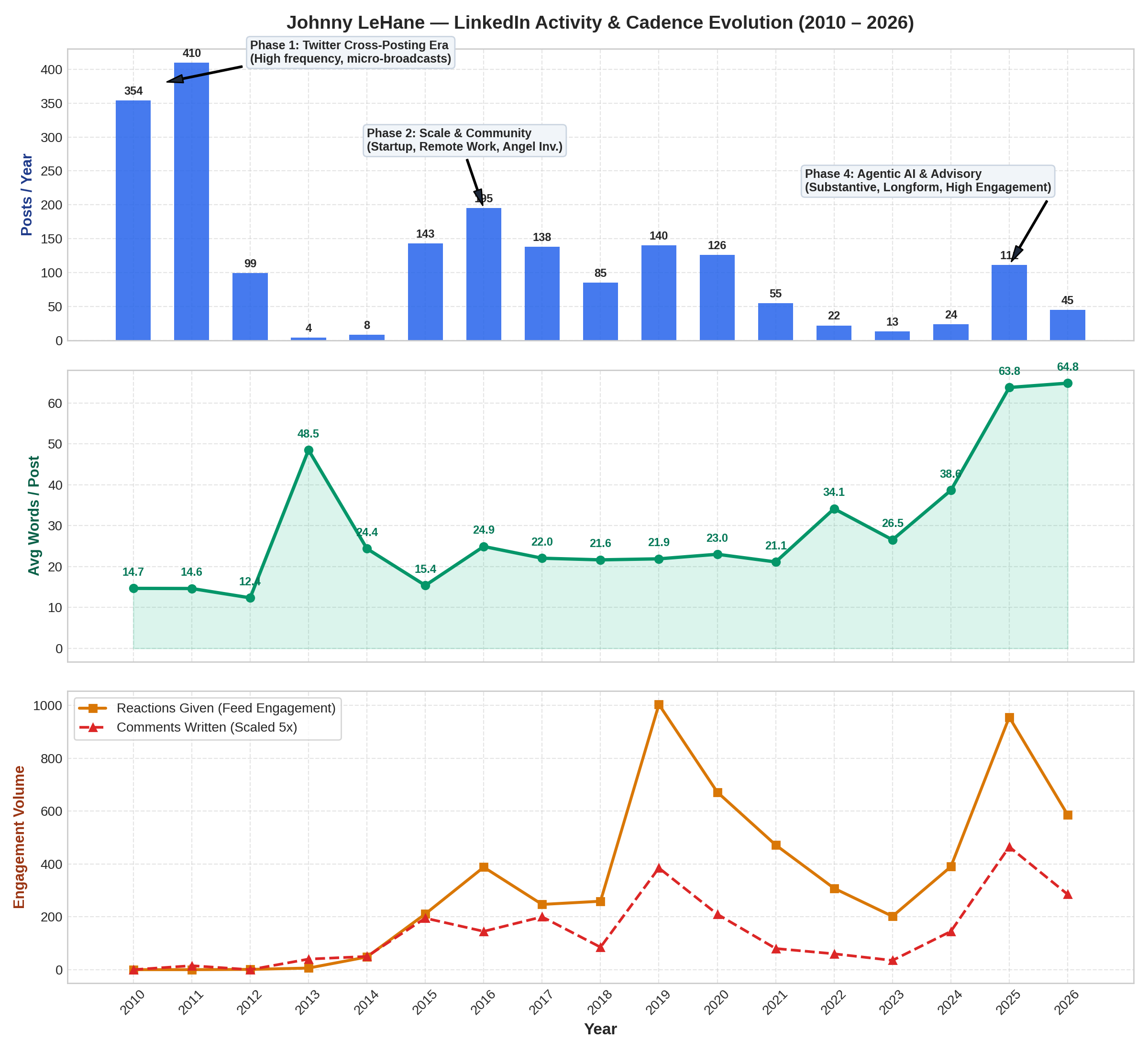
1. 17-Year Volume, Depth & Platform Footprint (2010–2026)
Comparing total posts published, average words per post (intellectual depth), and feed interaction volume over 17 years.
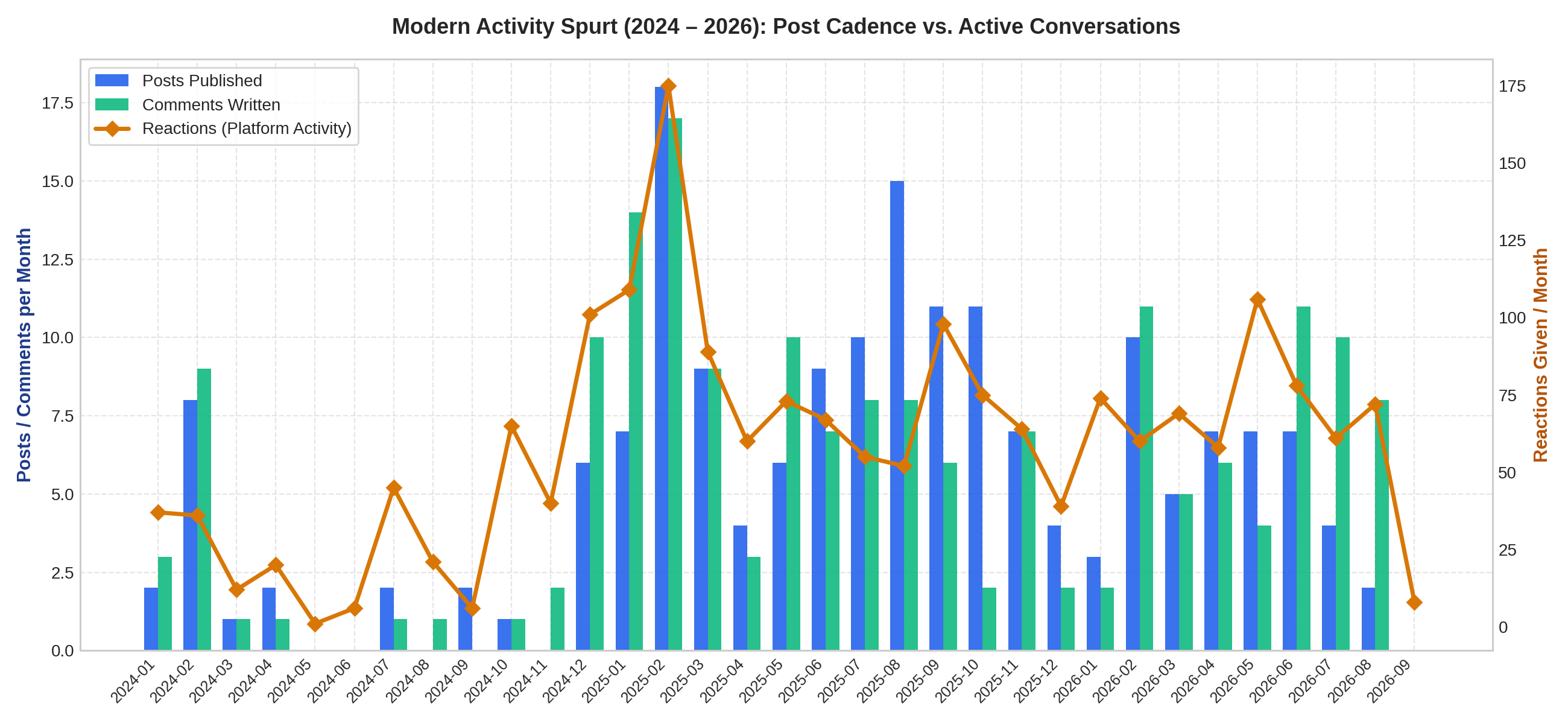
2. Modern Resurgence (2024–2026): Post Cadence vs. Active Conversations
Monthly breakdown of post cadence alongside comment interactions and feed reactions during the current Agentic AI advisory era.
The 4 Eras of Content Strategy
The High-Frequency Broadcast Era
Automated Twitter cross-posting, event check-ins, short links. 14.6 words a post and under 3 comments a year. Lots of output, almost no conversation.
Transition & Incubation
I went quiet while I was heads down running the company. A few announcements, nothing else.
Scale, Remote Work & Angel Investing
Back and busy. Posts grew to 22 to 25 words, about remote work (which I had been doing since 2004), scaling startups, and angel investing. Reactions hit about 1,000 a year in 2019.
Agentic AI, Systems & Advisory Resurgence
Frameworks, hands-on agentic engineering notes, and invitations to local events. One comment written for every 1.1 posts. This is the period with the most real conversation.
5 Winning Post Archetypes
Cross-referencing engagement records revealed that top-performing posts consistently match five distinctive structural formulas:
1. Practical AI & Agentic Realism
What I learned with my hands on the keyboard this week, and no hype. OpenRouter routing, MCP connectors, an AI’s read of my own coaching session.
2. Dual-Pillar Frameworks (Advisory + Coaching)
Two practices I push on with clients, put together into a numbered list you can act on.
3. Contrarian Historical Perspective
Something I did 20 years ago that explains what is happening now. Remote companies since 2004. Watching the case numbers go exponential in late 2019.
4. Regional Ecosystem Mobilization
A plain invitation to Hudson Valley founders: come outside, walk, talk strategy.
5. Authentic Inquiries & Conversational Probes
A real question I have, asked plainly. Which bank. Why the connector cannot tell which Google account I am in.
What This Teaches Us About AI Personalization
1. Data Mining Over Prompt Engineering
Telling an AI to "sound authoritative and visionary" gets you buzzword soup. Feeding it 100+ of my real posts, tied to real milestones (remote leadership since 2004, the fund, MCP work), gets something I would sign.
2. The 1-to-1 Publishing-to-Dialogue Ratio
AI makes it easy to post more. The data says the value comes from answering. A 1:1 ratio between posts and comments is where engagement compounded.
3. Scannability is Respect for Attention
My best posts are 50 to 120 words, in paragraphs of one to three sentences, with a numbered takeaway when there is one. One-line link dumps and 1,000 word walls both underperform.
4. Grounding in the 3-Draft Loop
This corpus is now the middle-draft engine for the 3-Draft Workflow. I frame, the machine expands from my own history, I judge. Faster, and it still sounds like me.